
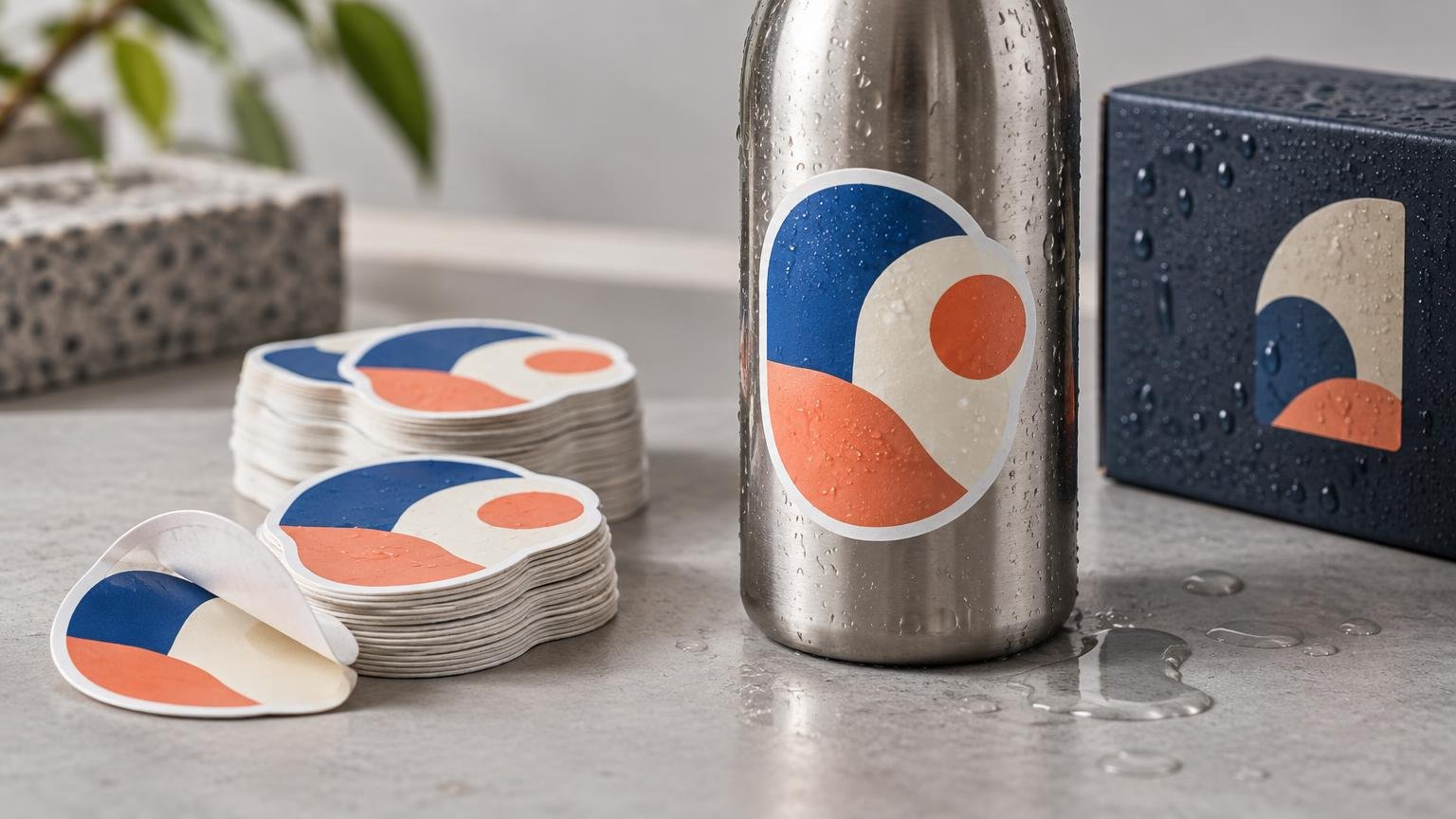
TLDR: Before ordering waterproof stickers in bulk, define the actual exposure rather than relying on the word “waterproof.” Check the face material, laminate or coating, adhesive, application surface, temperature, handling, and supplier-specific durability claims. Test the exact construction on the real bottle, package, cooler, or other item before scaling. Use individual stickers for giveaways and rolls for repeated packaging work, then base the quantity on expected consumption plus a controlled reserve.
For waterproof stickers what to look for depends on where the stickers will go and what will happen to them. A bottle that develops light condensation presents a different challenge from a tumbler washed repeatedly, a cooler left outdoors, or a refrigerated package labeled before sale. No single material name answers all of those questions.
The practical buying rule is simple: turn “waterproof” into a written specification, order a physical sample or short run, and reproduce the real application conditions. That extra step matters much more when you are preparing to order 1,000, 5,000, or 20,000 pieces.
Start by defining the moisture exposure
Water can reach a sticker in several ways. Occasional splashes test the printed face and edges. Condensation can sit against the adhesive line for hours. Washing adds water, heat, detergent, abrasion, and repeated cycles. Outdoor placement introduces rain along with sunlight, temperature changes, dirt, and handling.
Write down the expected scenario before requesting a quote. Useful descriptions include:
- Promotional stickers applied by customers to clean water bottles or coolers
- Product labels applied to dry bottles that later develop condensation
- Labels applied directly to cold or damp containers
- Event giveaways that may be used outdoors but are not intended for washing
- Reusable tumblers exposed to hand washing or dishwasher cycles
- Outdoor equipment exposed to rain, sunlight, abrasion, and temperature changes
- Packaging that may encounter water, oil, cleaning products, or refrigerated storage
This description gives the printer something meaningful to evaluate. “Waterproof” by itself does not establish dishwasher safety, outdoor life, wet-surface adhesion, or resistance to oils and cleaners.
Waterproof stickers: what to look for in the construction
A sticker is a system made from a printable face material, ink or toner, optional protective layer, adhesive, and release liner. The finished construction matters more than the face material alone.
Face material
Vinyl is commonly considered for moisture-exposed promotional stickers, while BOPP is frequently discussed for packaging labels. Paper may be appropriate for dry, temporary indoor applications, but it should not be assumed suitable for prolonged moisture exposure. Sticker Lots’ material overview distinguishes vinyl, paper, clear materials, BOPP, and protective coatings or laminates rather than treating every sticker as interchangeable. For a broader material explanation, see the guide to custom vinyl stickers and ordering considerations.
Do not stop at “vinyl.” Ask for the exact product construction and its intended environment. CustomStickers, for example, describes its waterproof product as vinyl protected by a laminate and markets it for bottles, coolers, weather exposure, and dishwasher use. Those are claims about that supplier’s specified product, not proof that every vinyl sticker performs the same way.
Laminate or protective coating
A laminate or coating can protect the printed surface from moisture, rubbing, and handling. Ask whether protection is included in the quoted product, whether it covers the entire printed face, and what happens at exposed edges. Also confirm whether the durability claim applies to the finished printed sticker rather than only to the unprinted base material.
Adhesive and application surface
The adhesive has to match the substrate. Smooth bottles, textured coolers, flexible pouches, coated boxes, glass jars, and curved tumblers do not present the same bonding conditions. CustomStickers states that its vinyl stickers are intended for hard, smooth, clean surfaces and advises removing dirt before application. That guidance should not be generalized to every adhesive or every surface.
Water resistance after application also does not prove that a sticker can be applied while the surface is wet. A useful parallel comes from the ASTM water-resistance method for tape and adhesives, which states that a result showing no dissolution or dispersion does not necessarily ensure satisfactory wet bonding. The method concerns box-closure tape rather than custom stickers, but the narrow principle is relevant: surviving water and bonding successfully under wet conditions are separate questions.
Test the real surface, not a substitute
A sample placed on a flat desk cannot tell you how the same sticker will behave on a narrow bottle, a flexible pouch, or a textured cooler. Test the final size, shape, material, finish, adhesive, and print method on the actual item whenever possible.
Apply samples using the same process planned for the full run. Clean and dry the surface, avoid touching the adhesive, press the sticker across the entire area, and allow any supplier-specified dwell time before exposure. If production labels will be applied to chilled products, ask whether they should instead be applied before chilling and test both the application process and the later refrigerated environment.
Curvature is especially important. A large, rigid sticker may bridge or lift when wrapped around a tight curve. Print a paper template at actual size first, then use a production sample to evaluate edge lift, wrinkles, readability, and placement. The same sizing discipline used for small-business packaging stickers applies here, but the waterproof test must use the final material rather than paper alone.
Choose a format that matches distribution
| Format | Best fit | Bulk-planning issue |
|---|---|---|
| Die-cut singles | Event handouts, promotional packs, merchandise inserts | Easy to distribute, but loose pieces require counting and storage |
| Kiss-cut sheets | Multiple designs, organized handouts, small application teams | Convenient grouping, but verify how many usable stickers are on each sheet |
| Roll labels | Repeated application to bottles, jars, pouches, boxes, or mailers | Plan around labels per roll, roll direction, applicator needs, and SKU changes |
Sticker Lots describes rolls as a packaging-oriented format for higher-volume application, while individual formats are better suited to stickers meant to be handed out or collected. If application speed and storage are major concerns, the guide to sticker rolls and custom roll labels explains the operational tradeoffs in more detail.
Format does not make a sticker waterproof. A roll label and a die-cut sticker can use different constructions even when they carry the same artwork. Request specifications for the exact format being quoted.
Use a sample-first bulk ordering workflow
A digital proof checks artwork, dimensions, spelling, and cut lines, but it cannot demonstrate adhesion or durability. CustomStickers distinguishes digital proofs from physical test orders and says physical samples can be used to assess finish, fit, readability, adhesive behavior, and real-world use before a bulk purchase.
- Finalize the intended surface, size, shape, material, laminate or coating, adhesive, and format.
- Request a digital proof to verify artwork and production boundaries.
- Order the exact physical specification being considered for the bulk run.
- Apply samples to real products using the planned production method.
- Expose them to realistic condensation, washing, rain, handling, refrigeration, or abrasion.
- Inspect edge lift, bubbles, fading, ink damage, adhesive residue, readability, and QR-code scanning.
- Approve the bulk order only after the sample passes the conditions that matter to your use case.
When comparing suppliers of custom waterproof stickers, ask whether a sample uses the same construction and printing process as the eventual bulk order. A generic material swatch can help with appearance, but it may not validate the complete printed product.
Plan quantity around use, reserve, and reorder risk
The lowest unit price is not automatically the lowest-risk order. A larger run can reduce unit cost, but it also locks in the design, dimensions, material, and performance assumptions. If the product changes or the sticker fails on the intended surface, unused inventory becomes more expensive than a timely reorder.
Build the order from expected consumption rather than a round number. For a hypothetical event, suppose a team expects 600 attendees, plans an average of 1.2 stickers per attendee, needs 80 for sponsors and staff, and wants a 10% reserve. The planning quantity would be 600 × 1.2 + 80 = 800, followed by an 80-piece reserve, for 880 stickers. The arithmetic is an estimate, not a universal attendance rule.
Packaging labels need a different model. Start with expected units sold or packed during the period before a reorder could arrive. Add labels for setup waste, damaged containers, samples, photography, replacements, and normal production errors. Keep the reserve modest when artwork, ingredients, regulatory copy, container size, or seasonal branding may change.
A useful quantity worksheet separates four buckets:
- Core campaign or packaging consumption
- Staff, sponsor, retailer, or sample requirements
- Application waste and damaged-item replacements
- A reserve sized to the realistic reorder lead time
Compare the delivered cost at two or three quantities, not merely the headline unit price. Include shipping, setup charges, premium material or laminate costs, storage, and the financial risk of obsolete inventory. The broader guide to when bulk custom sticker printing makes sense can help with the final quantity decision.
Questions to ask before placing the order
- What are the exact face material, print protection, adhesive, and liner?
- Does the quoted product include laminate or another protective coating?
- What exposure does the supplier’s “waterproof” claim cover?
- Is a dishwasher claim based on a specific construction, cycle, temperature, or expected number of washes?
- Can the sticker be applied to a cold, damp, curved, textured, or flexible surface?
- How long should the sticker remain dry after application before exposure?
- Does the outdoor-life claim cover print appearance, adhesion, or both, and under what conditions?
- Can I order a physical test using the exact bulk specification?
- Will the bulk run use the same material and production method as the sample?
- For rolls, what are the core size, unwind direction, roll diameter, and labels per roll?
- What quantity breaks change the delivered total, and how quickly could I reorder?
Treat precise lifespan claims as product-specific. CustomStickers publishes a claimed effective outdoor life of more than five years for its waterproof sticker product, for example, but that should not become a general benchmark for all vinyl stickers or every climate and surface. Outdoor buyers should also review common weatherproof sticker design and placement mistakes, since material choice cannot compensate for unreadable artwork or unsuitable placement.
Common waterproof sticker questions
Does vinyl automatically mean waterproof?
No. “Vinyl” identifies the face material at a broad level, not the full construction or tested performance. Ink system, laminate, edge exposure, adhesive, surface, and application conditions all matter. Ask what the finished printed product is designed to withstand.
Are waterproof stickers always dishwasher safe?
No. Dishwasher safety is a separate, supplier-specific claim involving heat, water, detergent, abrasion, and repeated cycles. Request the applicable conditions and test a finished sample on the actual item. Even when a supplier markets a product for dishwasher use, do not transfer that claim to another material or printer without confirmation.
Is vinyl or BOPP better for wet packaging?
Neither is universally better based on moisture alone. The decision depends on the container, curvature, flexibility, temperature, condensation, oils, application equipment, label life, and desired finish. BOPP is often considered for repeated packaging labels, while vinyl is common for durable promotional stickers, but the exact adhesive and protective construction still need to match the job.
Can a waterproof QR-code sticker still scan?
It can, but waterproof construction does not guarantee scan performance. Print the code at its final size, preserve adequate contrast and clear space, avoid placing it across a tight curve or seam, and test it after realistic moisture, glare, abrasion, and handling. Check with several phones before approving a large run.
Order the proven specification, not the label
The best bulk order is not simply the product with “waterproof” in its name. It is the construction that matches the actual surface, moisture, temperature, handling, application method, and required service life. Define those conditions, test the exact finished sticker, and only then choose the quantity break.
For giveaways, that may mean laminated die-cut vinyl singles tested on bottles and coolers. For packaging, it may mean a roll label tested on the actual container through condensation, storage, and handling. In both cases, a smaller validation order protects the much larger investment that follows.
References
- Sticker Lots Printing
- Waterproof Stickers | Durable Custom Stickers – CustomStickers.com
- Custom Vinyl Stickers | Waterproof and Durable – CustomStickers.com
- D5570 Standard Test Method for Water Resistance of Tape and Adhesives Used as Box Closure
Low-Risk Sampling Test Orders: How To Test Custom Stickers Before Buying In Bulk – CustomStickers.com