
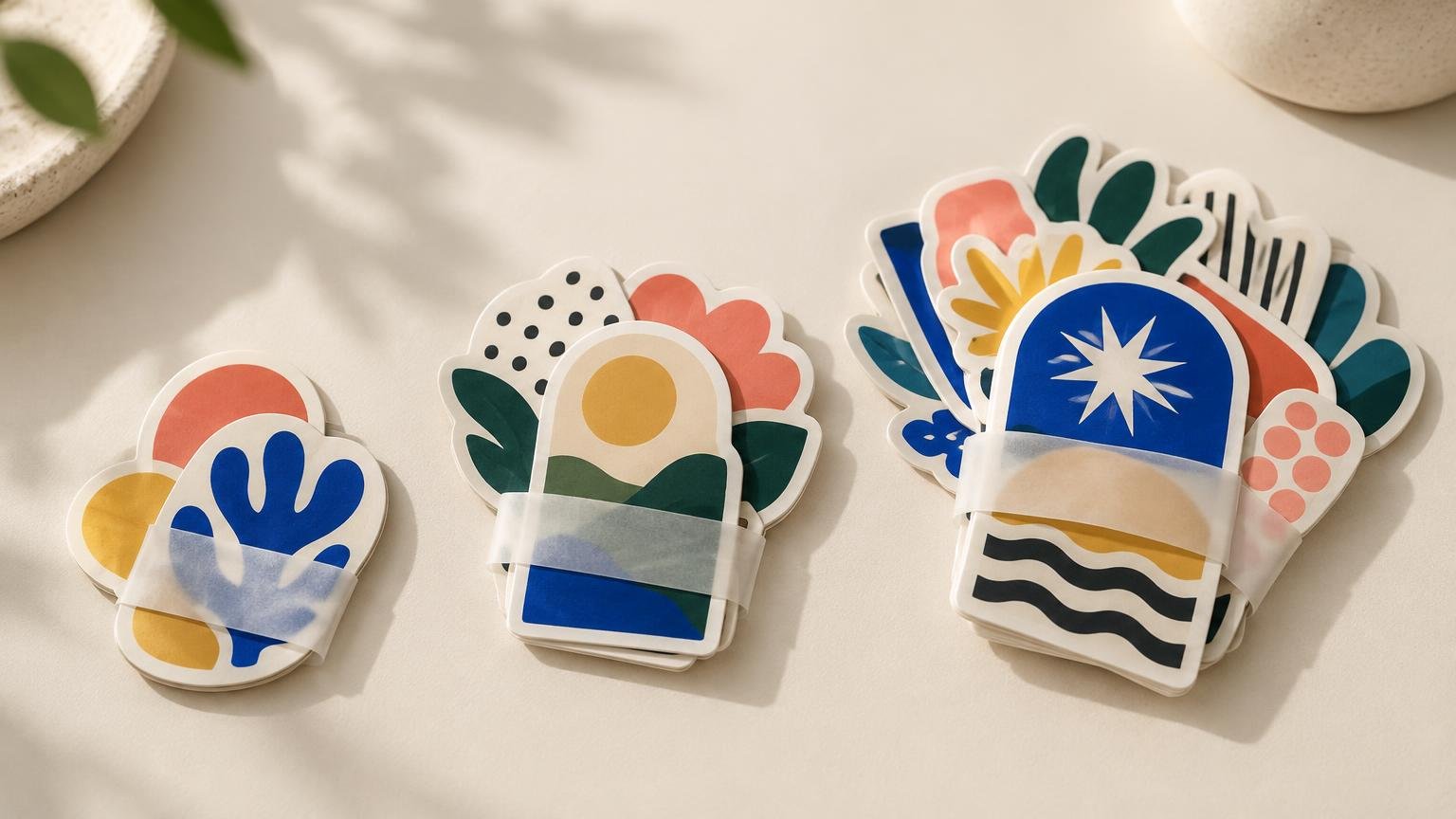
TLDR: For sticker pack quantity 3 vs 5 vs 10, choose three for a focused, low-commitment add-on; five for a balanced core assortment; or ten for a substantial collection with enough distinct artwork to justify it. These are planning models, not universal rules. Price the completely assembled pack, test its packed weight and dimensions, and consider design-change risk before committing to inventory.
This comparison concerns the number of stickers inside one customer-facing pack, not how many packs you should order. It also treats piece count and design count separately: a 10-pack might contain ten unique designs, five designs supplied twice, or one design in ten color variations. That distinction affects artwork preparation, production quantities, replacement inventory, and how customers understand the offer.
Sticker pack quantity 3 vs 5 vs 10 at a glance
| Pack size | Useful planning role | Main strength | Main risk |
|---|---|---|---|
| 3 stickers | Add-on, giveaway, introductory set, or tightly themed release | Simple proposition with a low artwork burden | May feel slight if the theme, presentation, or price does not establish clear value |
| 5 stickers | Regular merchandise SKU or compact themed assortment | Enough variety to feel like a set without requiring a large series | Can become visually inconsistent if designs were not developed as a group |
| 10 stickers | Full collection, seasonal release, or premium bundle | Substantial assortment and room for a broader concept | More artwork, assembly, packaging space, inventory, and replacement planning |
The most useful question is not which number sounds most generous. Ask what job the pack performs in the merch lineup. A checkout add-on, event handout, regular retail item, and limited collection have different pricing and presentation needs.
Choose a 3-pack for a focused, easy-to-explain offer
A 3-pack works well when the concept can be understood immediately: three characters, three logo treatments, or one hero design with two supporting designs. With fewer pieces competing for space, each sticker can potentially be larger, although the actual dimensions depend on the printer and package format.
Three pieces also make assembly and stock reconciliation relatively simple. If you prepare 100 identical packs containing three unique designs, you need 100 usable copies of each design, or 300 stickers total. That is arithmetic rather than a recommended order quantity; spoilage allowances, samples, replacements, and printer minimums still need separate consideration.
The weakness is that a paid 3-pack cannot rely on quantity alone to communicate value. A coherent theme, desirable artwork, useful sticker size, and deliberate packaging matter. If customers can buy single stickers from the same series, the pack should have a clear reason to exist, such as a coordinated trio, convenient bundle, or exclusive combination.
Choose a 5-pack for a balanced core assortment
Five stickers can provide noticeable variety without demanding a ten-design collection. It may suit a regular merchandise SKU when you have several finished designs that share a visual theme, audience, or campaign. Five is not an industry-standard answer; it is simply a practical middle option.
This count also creates several assortment possibilities. You could use five unique designs, four supporting designs around one hero image, or a smaller number of designs with intentional duplicates. State the contents clearly so the buyer does not assume that five pieces means five unique artworks.
At 100 packs, five pieces require 500 stickers. If all five designs are unique and ordered separately, the usable quantity of the least available design limits how many complete packs you can assemble. Keeping a component-level inventory count is therefore more useful than recording only the number of finished packs.
Choose a 10-pack when the assortment earns the extra volume
A 10-pack makes the most sense when the collection itself is the product: a full character series, seasonal set, event collection, or broad brand assortment. It can occupy a more substantial position in the lineup, but a higher piece count does not automatically create stronger perceived value.
Ten weakly differentiated designs may feel repetitive, while ten visually unrelated pieces may feel accidental. Review the set as one product. Check that every design remains readable at its finished size and that supporting pieces contribute something beyond making the count larger.
The operational commitment rises quickly. One hundred 10-packs require 1,000 finished stickers. Ten unique designs require balanced quantities across ten components, and one delayed or depleted design can prevent completion of the whole set. Assembly takes more handling, and the package may need additional area or thickness. Build and inspect a physical sample rather than assuming a sleeve or topper designed for a smaller set will still work.
Compare cost per pack, not only cost per sticker
Quantity discounts can make a larger print run look efficient at the sticker level, but a merch pack has costs beyond printing. Calculate the total cost of one saleable pack using the same definition for every option.
- All sticker components, including intentional duplicates
- Clear sleeve, resealable bag, envelope, or other primary package
- Backer card, topper card, hang tab, insert, or barcode label
- Assembly and quality-control time
- Outer mailer and protective material used for fulfillment
- Postage, platform fees, and any fulfillment charges
- Allowance for samples, damaged components, and incomplete sets
When obtaining quotes for the loose printed components, compare equivalent sizes, materials, finishes, and quantities from suppliers offering custom stickers. A cheap 10-pack is not automatically better value if it forces smaller artwork, needs a more expensive package, or leaves you holding a long-lived seasonal design. Conversely, a 3-pack is not automatically the economical choice if packaging and assembly represent most of its cost.
Use cost per sticker to understand production efficiency, but use cost per finished pack to set prices and margins. If several pack counts will be offered together, make their roles and price steps understandable rather than allowing them to compete without a clear distinction.
Verify artwork and provider-specific layout limits
A printer’s sticker-pack rules can constrain both the number and size of designs. For example, Sticker Mule currently describes packs supporting two to seven designs and retail presentation involving a resealable bag, hang tag, and kraft backing. Its FAQ says the designs share a combined 10-by-10-inch layout area. Those are provider-specific conditions, not general rules for every sticker pack.
Jukebox Print presents a different configuration, advertising one to ten stickers per pack, 3-by-3-inch and 4-by-4-inch formats, clear bags, printed toppers, and an optional hang hole. The difference illustrates why sellers should choose the intended count only after checking the selected printer’s current pack format and layout rules.
Ask the printer whether its stated limit refers to pieces, unique designs, or both. Also confirm whether each design can have a different cut shape, whether duplicated artwork must be supplied more than once in the layout, and whether individual sticker dimensions or the combined layout area control the pack.
File requirements are also provider-specific. Sticker Mule, for example, publishes a 300 PPI minimum for raster artwork and separate guidance covering borders, bleed, fonts, and line sizes. Treat that as an example rather than a universal specification, and obtain the actual template and requirements from the printer producing the job.
Build and ship a representative sample before launch
A digital mockup cannot confirm whether ten finished stickers sit neatly in a sleeve, obscure the backer artwork, or create an awkward bulge. Assemble one representative version of every pack count under consideration using production-size stickers and the intended packaging components.
- Arrange the stickers in the sleeve or bag as a customer would receive them.
- Add the real backer, topper, insert, barcode, and closure.
- Check visibility, movement, edge pressure, and whether the package closes cleanly.
- Place the completed pack in the intended shipping mailer with any other normal order contents.
- Measure the final length, width, thickness, and weight using appropriate tools.
- Use those packed measurements when checking postage and free-shipping thresholds.
The USPS Ground Advantage guidance states that package pricing is based on weight and zone, with dimensional considerations applying where relevant. That makes the fully packed shipment—not a loose sticker or empty mailer—the useful object to measure. Shipping services and rates can change, so verify the applicable rules when the product is ready to launch.
This test also helps determine whether a larger pack is compatible with your display method. If a store needs hang-hole packaging, confirm that the hole remains unobstructed and that the pack hangs without excessive bending. If the product ships as an order insert, check it against the smallest mailer normally used.
Give each pack size a distinct role in the merch lineup
One optional lineup model is to offer single stickers as entry items, 3-packs as themed add-ons, 5-packs as the regular set, and 10-packs as full or seasonal collections. That hierarchy is not compulsory. A brand with only three strong designs may be better served by one excellent 3-pack than by stretching the series to fill larger bundles.
Check for unnecessary overlap. If the 5-pack contains the same five designs sold individually, explain what convenience or pricing logic distinguishes it. If the 10-pack merely combines two existing 5-packs, decide whether that simplicity is a feature or whether the larger set needs exclusive art or presentation.
Pack count and production quantity are separate decisions. Once the configuration is settled, use expected sales, campaign duration, storage, and artwork stability to compare orders of 100, 500, or 1,000 custom stickers. If the designs are finalized and likely to remain useful across multiple campaigns, the case for bulk custom sticker printing becomes stronger. A short seasonal window or likely artwork revision favors more reorder flexibility.
Plan for reorders at the component level
Multi-design packs can become incomplete when one component runs out before the others. Maintain a simple inventory record showing usable quantities for each design as well as assembled packs. If operationally practical, hold a modest pool of unassembled components for replacements, photography, samples, or correcting an uneven count.
Do not solve every imbalance by placing the largest possible initial order. A design change, expired campaign message, packaging revision, or weak-performing piece can make excess inventory difficult to reuse. Order confidence should rise with design stability, campaign length, available storage, and predictable consumption.
Final decision checklist
- What is the pack’s role: paid merchandise, checkout add-on, giveaway, event handout, seasonal release, or complete collection?
- Does the count mean total pieces, unique designs, or a combination of unique designs and duplicates?
- Are all included artworks final and readable at the intended physical size?
- Does the printer permit the proposed design count, dimensions, shapes, and combined layout?
- What does one completely assembled pack cost, including packaging, labor, mailer, and postage?
- Does a physical sample fit the intended sleeve, backer, display, storage, and fulfillment method?
- What are the measured weight and dimensions of the packed shipment?
- How many complete packs can be assembled if one design has fewer usable copies than the others?
- How long will the campaign run, and how likely are artwork or branding changes?
- Does this pack complement singles and other bundles rather than duplicate their role?
The practical choice
Start with the smallest count that delivers a complete, convincing concept. Choose three when the idea is naturally tight, five when you have a balanced core assortment, and ten when the artwork and presentation support a true collection. Then prototype the whole product—not just the stickers—before ordering at scale.
The winning count is the one you can explain, assemble, ship, track, and reorder without unnecessary friction. Finalize the contents, test the package, calculate the finished-pack cost, and only then decide how many packs to produce.