
TLDR: Order custom food and beverage labels for the production you can realistically complete before the design, package, formula, or required copy changes. Roll labels usually suit repeated product application, but quantity should be planned separately for each SKU. Test the proposed label on the actual container under realistic refrigeration, condensation, handling, and shipping conditions. Save the approved proof and production specifications so the next order is a controlled reorder rather than a reconstruction.
The cheapest custom food and beverage labels are not necessarily the labels with the lowest quoted unit price. A larger run can reduce printing cost per label while increasing the risk of obsolete inventory. The right quantity balances production volume, application waste, storage, design stability, lead time, and the cost of running short.
Start with a label run plan, not a price break
Begin with the number of saleable units you expect to package during a defined window. That window might be one production batch, a season, a wholesale commitment, or the period before your next scheduled packaging review. Do not combine every flavor or size into one forecast unless all versions use exactly the same label.
For each SKU, record the planned packaged units and then add separate allowances for production errors, quality-control samples, photography, sales samples, events, damaged containers, and replacement stock. Keeping these allowances visible is better than hiding them in an unexplained round number.
For example, imagine a business plans to package 1,200 bottles of one flavor. It expects to use 40 labels during setup and application practice, 30 for samples, and 20 for replacements. Its working requirement would be 1,290 labels. This is an illustrative calculation, not a universal waste allowance: an experienced hand-application process may need a different buffer from a new machine setup.
If you are deciding among common order tiers, the same inventory logic used in comparing 100, 500, and 1,000 custom stickers applies here. The important difference is that packaging labels can become unusable when a formula, barcode, package size, or required statement changes.
Choose roll labels for a repeatable application workflow
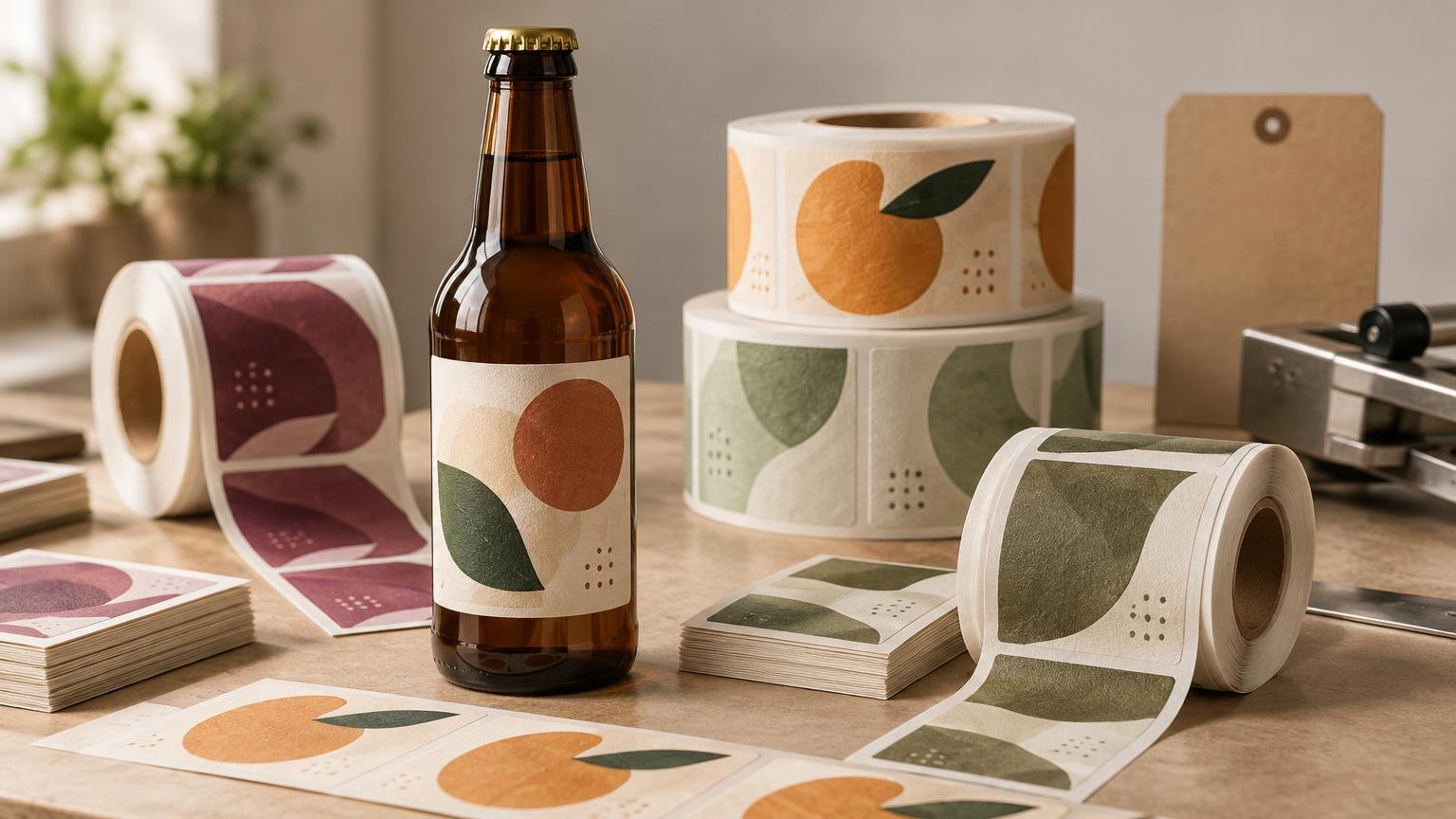
Roll labels are often practical when workers repeatedly apply the same design to jars, bottles, cans, pouches, boxes, or other packages. Rolls are compact to store and can support hand application or compatible dispensing equipment. CustomStickers describes its roll labels as suitable for application by hand or equipment and lists quantity selections from 250 through 5,000 on the cited product page. Those are that seller’s published options, not an industry-wide range.
Individually cut stickers can still make sense for very small trials, promotional handouts, or situations where the printed piece is not part of the main packaging workflow. The distinction is explored further in the guide to packaging labels versus promotional stickers. For repeated product labeling, however, loose pieces usually introduce more backing waste and handling than a roll.
Before buying machine-applied rolls, obtain the applicator requirements. Confirm the core size, roll diameter, unwind direction, gap between labels, label orientation, and acceptable shape. A roll that contains the correct artwork can still be operationally wrong if it feeds backward or does not fit the equipment.
For a closer look at storage and application tradeoffs, see the guide to sticker rolls and custom roll labels. Buyers ready to review available printing formats can also browse custom stickers and labels, but the production specification should be settled before quantity alone drives the order.
Match the construction to the real container conditions
Food and beverage packaging can expose a label to refrigeration, condensation, ice, oil, repeated handling, abrasion, and temperature changes during shipping. Material names such as paper, film, matte, or gloss do not by themselves establish how the complete label construction will perform. Facestock, adhesive, ink, finish, container surface, and application conditions work together.
Avery Dennison’s adhesive technical overview notes that moisture or condensation can interfere with pressure-sensitive adhesion and that cold temperatures can reduce initial tack. That makes application timing important. A label intended for a refrigerated bottle may need to be applied to a clean, dry container under controlled conditions before chilling, rather than pressed onto a wet bottle just removed from a cooler.
Ask the printer to recommend a construction for the actual exposure, then test it on the production container. A useful trial should reproduce application temperature, time before refrigeration, condensation cycles, handling, and the expected storage period. Test filled packages when their shape or surface behavior differs from an empty sample. Do not treat broad descriptions such as “water-resistant” or “freezer-safe” as substitutes for a use-specific trial.
Measure the usable label panel
Measure the part of the package where a label can sit flat, not the package’s total width and height. Ridges, seams, shoulders, compound curves, and tapered walls reduce usable space. A rectangular label wrapped around a sharply tapered cup may wrinkle or lift even when its dimensions look correct on a flat proof.
- Identify the straight or least-curved section of the package.
- Measure several production containers rather than relying only on a catalog drawing.
- Create a plain-paper size mockup and apply it to a filled container.
- Leave appropriate clearance from seams, edges, caps, and high-curvature areas.
- Place required copy, lot information, and scannable codes inside the dependable print area.
- Print and scan test barcodes at actual size on the intended background, especially when using clear material.
If one label must fit multiple package sizes, verify every size. A shared front label may work, but required text and barcode panels can force separate versions. Bakery and prepared-food businesses may also find the workflow discussion in the guide to custom stickers for bakery boxes useful.
Plan quantity around SKU stability
A stable, reviewed design with predictable monthly use can justify a longer run. A new flavor, seasonal promotion, pilot package, pending formula revision, or unconfirmed barcode calls for more reorder flexibility. Treat every printed version as its own inventory item, even when the only difference is a flavor name or net quantity.
| Situation | Safer quantity approach | Reason |
|---|---|---|
| Established product with stable packaging | Cover a longer forecast window if storage and cash flow allow | Lower change risk makes a larger price break more useful |
| New product or package | Use a shorter initial run | Real sales, application speed, and packaging issues are still unknown |
| Seasonal or dated promotion | Order against the defined campaign window | Leftover labels may have little or no future use |
| Multiple flavors or sizes | Forecast each SKU separately | A strong seller cannot consume labels printed for a slower SKU |
| Pending formula or compliance review | Delay printing or keep the run short | Approved label copy may change before inventory is used |
Avoid ordering enough labels for a year merely because annual demand looks predictable. Ask what could change during that year: ingredients, allergen declarations, nutrition information, supplier details, net contents, barcodes, recycling claims, prices, package dimensions, or branding. The more unresolved items there are, the more valuable a smaller first run becomes.
Compare total operating cost, not just unit price
A quantity break is valuable only when the extra labels are likely to be used. Compare the delivered printing cost with storage, application labor, expected waste, cash tied up in inventory, rush-reorder exposure, and the cost of discarding obsolete labels.
Consider a hypothetical choice between 1,000 labels for $180 and 1,500 labels for $210. The larger run has a lower nominal unit cost: $0.14 instead of $0.18. But if a package change leaves 400 of those 1,500 labels unused, the business receives only 1,100 usable labels. Its effective printing cost becomes about $0.191 per used label. The larger order looked cheaper per printed piece but cost more per piece actually used.
The opposite can also be true. If demand is dependable, the artwork is settled, storage is suitable, and repeated small orders would add shipping or setup expense, the larger run may reduce total operating cost. Compare quotes at identical size, material, finish, artwork count, roll configuration, turnaround, and shipping basis.
Build a repeatable reorder record
A reliable reorder starts with version control. Save enough detail that another employee could identify the exact approved label without relying on memory or a filename such as final-v3-new.
- Approved proof and editable source artwork
- Product name, flavor, size, and internal SKU
- Finished label dimensions and shape
- Material, adhesive, finish, and any protective layer
- Roll core, unwind direction, orientation, and labels per roll
- Barcode version and location
- Printer order number, order date, and quantity
- Approval date and the person who authorized the copy
- Notes from the application and environmental test
CustomStickers says customers can reorder through an account or with a previous order number and can add notes requesting the same design. Whatever supplier you use, retain the full specification internally. “Same as last time” is useful only when the last order is unambiguous and no product information has changed.
Set a reorder point using expected consumption during supplier lead time plus a deliberate safety buffer. For example, if a business uses 300 labels per week and wants four weeks of coverage between placing and receiving an order, lead-time demand is 1,200 labels. Adding a 300-label operational buffer would create a reorder point of 1,500 remaining labels. Both the lead time and buffer in this example are hypothetical; substitute current supplier timing and your actual demand variability.
Complete a compliance review before printing
Printing a label and approving its content are different jobs. FDA states that food businesses are responsible for ensuring their labels comply with applicable requirements and are truthful and not misleading. FDA’s food-business labeling resources identify nutrition and major-allergen labeling among the relevant considerations. FDA also published its current Food Allergen Labeling Questions and Answers in January 2025. Review the FDA allergen-labeling guidance when it applies to the product.
Do not rely exclusively on an old food-labeling guide or a previous package. FDA notes that older sections of its Food Labeling Guide covering allergen and nutrition requirements do not reflect all current requirements. Have the applicable label content reviewed before approving a large run, especially after a formula, ingredient supplier, package size, claim, or regulatory requirement changes.
Alcoholic beverages require a separate regulatory check. TTB treats beer and malt beverage labeling and formulation approval as a distinct process and provides information about applicable rules and its Certificate of Label Approval process. Consult TTB’s beer and malt beverage labeling resources for those products. Wine and spirits businesses should use the product-specific TTB materials and obtain appropriate compliance guidance rather than assuming ordinary food-label rules are sufficient.
Common ordering questions
How many labels should a first run include?
Cover the confirmed production batch, samples, setup waste, replacements, and a modest buffer. Keep the initial run conservative when sales, packaging, application performance, or label copy remain uncertain.
Can labels be applied to cold or wet containers?
Do not assume they can. Moisture can interfere with adhesion, and low temperatures can reduce initial tack. Confirm the application conditions with the printer and test the proposed construction on clean, dry production containers under a realistic workflow.
Should several flavors be combined into one bulk quantity?
Use total volume to negotiate or compare the overall job, but forecast and control inventory by SKU. Each flavor needs enough labels for its own demand, and unused labels for a slow flavor cannot normally cover a faster one.
When should a business place a new order instead of a simple reorder?
Stop and review the artwork when the formula, allergens, nutrition information, net contents, barcode, package dimensions, claims, business details, or promotion has changed. A reorder should reproduce an approved current version, not automatically repeat outdated copy.
Order for usable inventory
The best quantity is the run you can apply before the label or package becomes obsolete. Forecast each SKU, choose a format compatible with the application workflow, test the complete construction on the real container, and compare effective cost per used label rather than price per printed label. Once the version is approved, preserve its production record and set a reorder point based on consumption, current lead time, and a deliberate buffer.
References
- Label Sticker Rolls – 2 Inch Custom Circle Roll Labels – Fast Stickers – CustomStickers.com
- Z3338 Adhesive Technical Overview
- How to Reorder – CustomStickers.com
- How to Start a Food Business | FDA
- Guidance for Industry: Questions and Answers Regarding Food Allergen Labeling (Edition 5) | FDA
- Guidance for Industry: Food Labeling Guide | FDA
- Beer and Malt Beverage Labeling and Formulation Approval | TTB: Alcohol and Tobacco Tax and Trade Bureau