
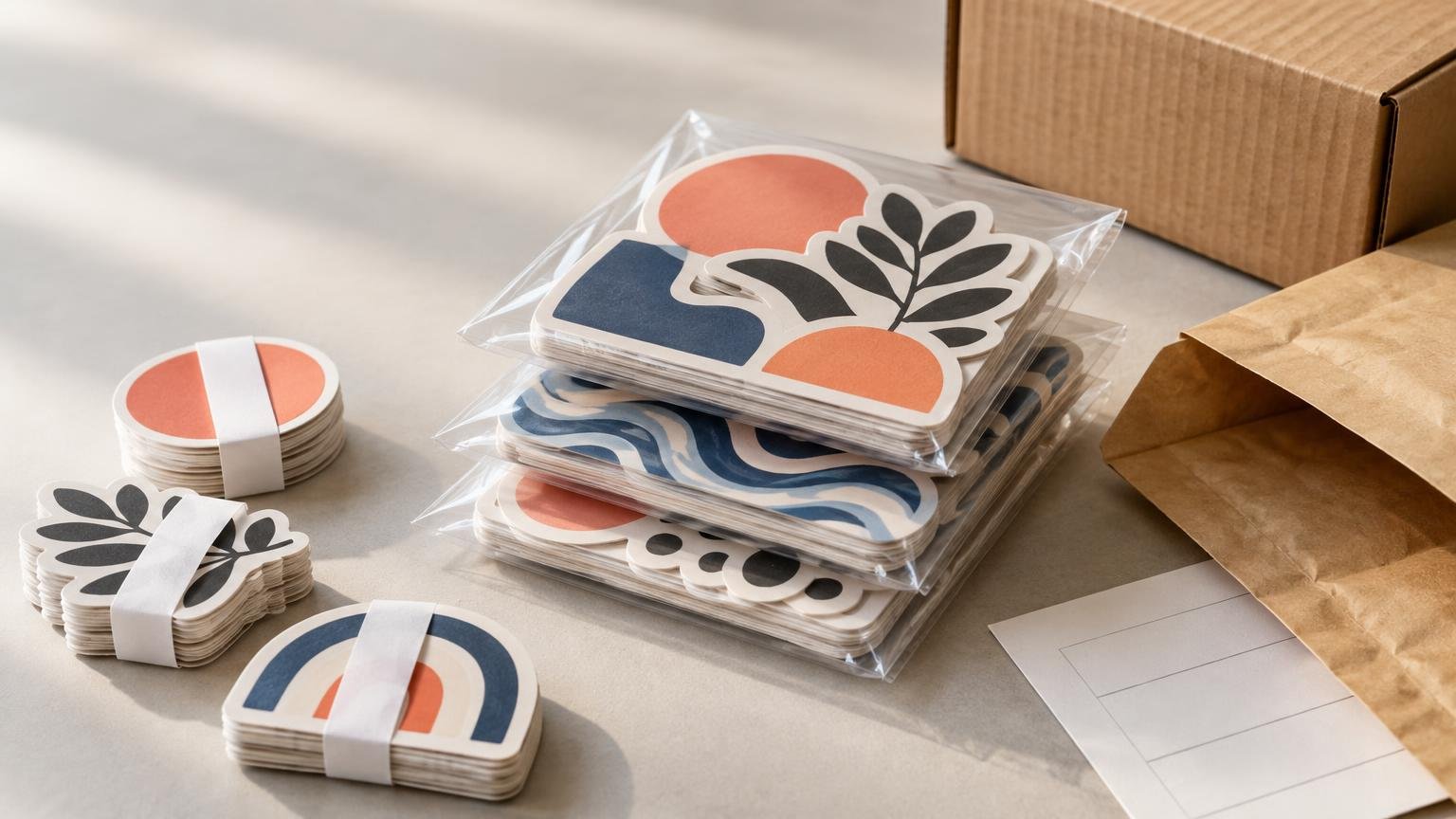
To sell sticker designs on Amazon, turn your original artwork into a clearly defined physical product, choose the appropriate Amazon selling route, calculate the full cost per sale, and launch with a controlled quantity. The goal is not to print the largest batch with the cheapest unit price. It is to learn which designs sell before slow inventory consumes your cash and storage space.
Start with a small range of coordinated singles, sheets, or packs rather than dozens of unrelated designs. Give each product a specific count, physical size, material, finish, package, and selling price. Those choices affect production cost, listing images, fulfillment charges, customer expectations, and how much inventory you should order.
Choose the right Amazon selling route
Amazon lists two general selling plans. The Individual plan costs $0.99 for each item sold, while the Professional plan costs $39.99 per month; referral fees and other selling costs apply in addition to either plan. The Professional plan adds bulk listing, advertising, and more advanced pricing and inventory tools. Sellers can switch or cancel plans after registering. Amazon’s current selling-plan comparison provides the details.
At the plan-fee level alone, $39.99 is roughly equal to the Individual plan’s per-item charges at 40 to 41 monthly sales. That is not a complete break-even calculation because it excludes referral fees, sticker production, packaging, fulfillment, storage, advertising, returns, and overhead. Still, it provides a useful checkpoint when deciding whether a test launch needs the Professional tools.
Amazon Handmade is a separate consideration. Applicants need a Seller Central account, a Professional plan during the application process, and maker approval. Amazon says it waives the ongoing monthly Professional selling fee after the first month for approved Handmade sellers. Handmade charges a referral fee of 15% or $0.30 per unit, whichever is greater.
Read the production rules before treating Handmade as the automatic choice. Amazon’s sticker-specific guidance says custom vinyl stickers must use original designs and be cut and created by the maker in the maker’s studio. Handmade also prohibits outsourced production, drop-shipping, third-party resale, and digital downloads. That makes the program a poor fit for a seller who plans to send artwork to a commercial printer and resell the finished stock.
If outsourced printing is part of your model, evaluate the ordinary Amazon marketplace route instead. You can compare custom sticker materials and artwork preparation through CustomStickers while planning a physical product, but do not represent commercially produced stock as Handmade unless it satisfies Amazon’s current eligibility rules.
Confirm that you can sell the artwork
Use artwork you created or have explicit commercial permission to use. The U.S. Copyright Office identifies stickers, decals, and bumper stickers as examples of visual-arts works. Names, logos, symbols, and designs can also function as trademarks, according to the United States Patent and Trademark Office. Amazon Handmade separately prohibits unauthorized reproductions that violate copyright or trademark rights.
Do not assume that changing colors, adding a phrase, or redrawing a recognizable character makes it safe to sell. Keep source files, licenses, commission agreements, and records showing who created each design. If ownership is unclear, resolve it before ordering inventory.
Calculate the complete cost of one sale
A sticker that costs 35 cents to print does not cost 35 cents to sell. Build the calculation around the finished sellable unit, whether that is one die-cut sticker, a five-piece themed pack, or a sheet in a protective sleeve.
- Production cost for every sticker included in the product
- Backing card, sleeve, rigid mailer, label, and other packaging
- Amazon referral and selling-plan fees
- Seller-fulfilled postage or FBA fulfillment and storage charges
- Inbound shipping to an FBA facility when applicable
- Advertising cost allocated to each sale
- Allowance for damaged products, returns, replacements, and unsold stock
- Labor for packing, labeling, inventory handling, and customer service
Amazon’s public fee table lists a 15% referral fee with a $0.30 minimum for several categories that might contain sticker products, but Amazon warns that a product’s fee category can differ from its customer-facing browsing category. Check the category assigned to the actual listing rather than building a margin around an assumption.
Calculate profit as selling price minus all variable costs and a reasonable share of fixed expenses. If a five-sticker pack sells for $9.99, run the numbers for the entire packed product—not for one loose sticker. Packaging can raise the weight and dimensions enough to change fulfillment economics.
Order launch quantities by design, not just in total
Use a larger batch only when the design is stable, the listing has demonstrated demand, and the savings exceed the cost of holding inventory. The framework in when to order wholesale sticker printing can help separate a real volume opportunity from an attractive-looking quantity discount. Compare delivered cost across quantity tiers rather than relying on the headline unit price; bulk pricing versus coupon discounts explains why the cheapest printed unit is not always the lowest-risk order.
| Demand stage | Practical quantity approach | Main objective |
|---|---|---|
| Unproven design | Order samples or the smallest workable batch | Verify print, packaging, images, and buyer response |
| Early sales | Reorder enough for a short selling window | Collect demand data without creating deep stock |
| Consistent seller | Move to the next economical quantity tier | Improve margin while retaining reorder flexibility |
| Seasonal or trend-led design | Keep coverage deliberately short | Avoid obsolete inventory after demand falls |
Set a reorder point using average weekly sales, supplier production time, shipping time, and a modest safety buffer. For example, a product selling 10 units per week with a three-week replenishment cycle needs more than 30 units on hand when the reorder is placed. Add a buffer based on sales volatility, but do not turn the buffer into another oversized batch.
Choose fulfillment around the actual product
Seller fulfillment gives you direct control over packing and can suit low-volume tests or personalized orders. Amazon states that Amazon Custom products must be fulfilled by the seller, and Handmade customized listings are also seller-fulfilled. Non-customized Handmade variations may be eligible for FBA.
With FBA, Amazon stores inventory and handles picking, packing, shipping, customer service, and returns. Charges can include fulfillment fees based on product price, dimensions, and weight; monthly storage based on occupied volume; and aged-inventory charges for stock held longer than 181 days. Amazon also uses restock limits and provides replenishment tools. Amazon’s FBA overview explains the current workflow and cost categories.
Before choosing FBA, enter the finished package dimensions, weight, category, selling price, and shipping assumptions into Amazon’s Revenue Calculator. Compare a loose sticker pack, a rigid mailer, and any larger multipack as separate configurations because the packaging can change the estimate.
Build a listing that matches the delivered product
Amazon requires at least one image on every detail page. Its main-image rules call for an accurate depiction of the complete product on a white background, with attention to real scale, color, and quantity. Amazon recommends six images and one video.
For a sticker pack, show the actual printed products and packaging rather than using an artwork collage as the main image. Make the pack count, individual sticker dimensions, material, finish, and included designs easy to understand. Secondary images can show scale, surface application, packaging, and close views, provided they do not imply that props or extra quantities are included.
Keep the physical product consistent with the listing. If you change the laminate, size, backing, pack count, or printer, verify that the listing remains accurate before shipping the revised stock.
Launch small, measure, and reorder selectively
Track sessions, conversion, units sold, advertising cost, returns, stock remaining, and profit by listing. After the first selling cycle, divide designs into three groups: reorder, revise, and discontinue. Increase quantities for proven products, improve listings or bundles with weak conversion, and stop financing designs that remain unsold.
The practical path is simple: establish your rights, choose the correct Amazon program, price the complete sellable unit, test a limited physical quantity, and scale only the designs that produce repeatable sales. Amazon can reward available inventory, but a sticker business stays healthier when reorders follow evidence rather than enthusiasm.
Frequently Asked Questions
What is the best way to start selling sticker designs on Amazon?
Define a physical product with a clear size, material, finish, pack count, packaging, and price. Start with a limited range and a controlled quantity so you can measure demand before committing more cash.
Should a new sticker seller choose Amazon’s Individual or Professional plan?
The Individual plan charges $0.99 per item sold, while the Professional plan costs $39.99 per month and includes more advanced listing, advertising, pricing, and inventory tools. Compare the tools you need as well as projected sales; referral fees and other costs apply to both plans.
Can commercially printed stickers be sold through Amazon Handmade?
Amazon’s sticker-specific Handmade guidance says original vinyl sticker designs must be cut and created by the maker in the maker’s studio. Outsourced production, drop-shipping, and third-party resale are prohibited, so commercially printed stock is generally a poor fit for Handmade.
Can I sell stickers featuring characters, logos, or popular phrases?
Only when you created the artwork or have the necessary commercial rights. Stickers can qualify as visual-arts works, while names, logos, symbols, and designs may function as trademarks. Keep source files, licenses, and commission agreements that document your rights.
What costs should be included when pricing an Amazon sticker pack?
Count production, packaging, Amazon fees, postage or FBA charges, inbound shipping, advertising, returns, damaged or unsold stock, labor, and a reasonable share of fixed expenses. Calculate margin for the complete packed product, not one loose sticker.
How many stickers should I order for an Amazon launch?
Use the smallest workable batch that can verify print quality, packaging, listing images, and buyer response. Treat every design or pack as a separate inventory risk rather than using the total order quantity as the only measure.
How should I set a reorder point for stickers?
Use average weekly sales, production lead time, shipping time, and a modest safety buffer. Increase quantities only after a listing shows repeatable demand, and keep seasonal or trend-led inventory deliberately short.
Is FBA or seller fulfillment better for stickers?
Seller fulfillment can suit low-volume tests and personalized products; Amazon Custom products and customized Handmade listings must be seller-fulfilled. FBA can handle storage, picking, packing, shipping, customer service, and returns, but dimensions, weight, storage time, and inventory levels affect its economics.
What images does an Amazon sticker listing need?
Amazon requires at least one image and says the main image must accurately show the complete product on a white background. For sticker packs, clearly show the real pack count, dimensions, finish, included designs, and packaging without implying that props or extra quantities are included.
References
- How much does it cost to sell on Amazon? | Sell on Amazon
- sellercentral.amazon.com
- sellercentral.amazon.com
- Visual Arts Examples
- What is a trademark? | USPTO
- Amazon Handmade | Sell on Amazon
- Amazon FBA (Fulfillment by Amazon) | Sell on Amazon
- Estimate fees and costs | Sell on Amazon
- sellercentral.amazon.com
- sellercentral.amazon.com