
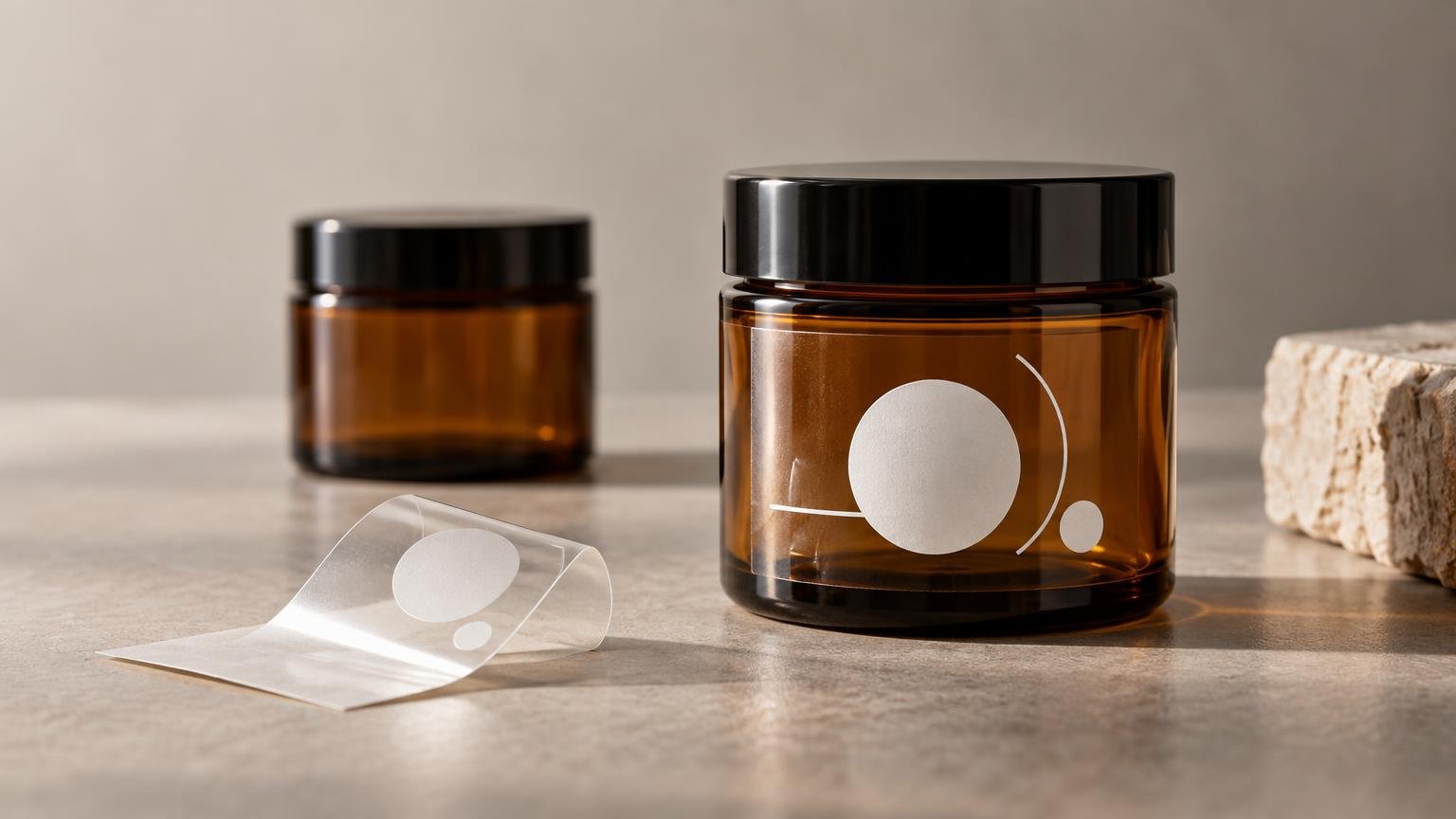
Clear stickers with white ink work best for branded packaging when you want areas of the container to remain visible without sacrificing logo, text or color contrast. Use white ink behind elements that must remain opaque, and leave it out where you want the package or product to show through. The result depends as much on the container, adhesive and finish as it does on the artwork.
The safest ordering process is to treat the sticker and package as one finished construction. A design that looks crisp on a white screen can lose contrast on amber glass, dark plastic or a product-filled container. Test the exact sticker on the actual package before committing to a large quantity.
Why white ink changes a clear sticker
Clear film does not provide the white background that ordinary color printing assumes. Without white ink, printed colors remain partly transparent, allowing the container and its contents to influence their appearance. A white underprint makes selected colors more opaque and improves the visibility of white text, pale graphics and fine details. Standard desktop printers generally cannot reproduce this white-ink effect.
White ink can perform two different jobs. It can sit underneath colored artwork as an underbase, or it can appear as a visible design color for white lettering, icons, borders and solid shapes. A sticker can use both approaches in the same design.
That flexibility creates the main design decision: which areas should remain transparent, and which need stable opacity? A clear field with white-backed branding often gives packaging a lighter visual footprint while keeping the important information readable. For a broader look at artwork problems on transparent film, review these common clear sticker design mistakes.
Choose the right white-ink treatment
Printers may describe white-ink setups differently, but the common approaches are flood white, image white and spot white. Confirm the supplier’s terminology and file requirements rather than assuming every press handles the layers in the same order.
| White-ink approach | What it does | Useful packaging application |
|---|---|---|
| Flood white | Places white beneath a broad image area | Artwork that should behave more like printing on white stock |
| Image white | Backs printed objects or text | Logos and illustrations that need stronger color |
| Spot white | Places white only in specifically defined areas | Mixed transparent and opaque effects with controlled placement |
| Visible white | Prints white as part of the design | White type, borders, icons or decorative details on clear film |
Spot white provides the most control when the package itself is part of the composition. It can support a logo and required text while leaving a clear window around the artwork. Exact layer naming, ink order and density remain process-specific, so request the printer’s artwork template or setup instructions before finalizing the file.
Let the package determine contrast and finish
Anything without white backing will borrow its appearance from the surface beneath it. Clear graphics tend to read more easily on glass, mirrors and light-colored surfaces, while dark containers can swallow thin lines and low-contrast colors. A product visible through a bottle can also change the design as the container fills or empties.
Glossy clear film is generally the better starting point when the goal is a highly transparent appearance. Matte clear material can create an intentionally frosted effect, especially on a dark surface. Neither finish guarantees invisible edges: the film, container texture, lighting and viewing angle can all make the sticker boundary noticeable.
Print an actual-size paper mockup first to confirm proportions, following the same measurement discipline used when choosing packaging sticker sizes. Then order a production proof using the selected clear film, white-ink map and laminate. Kodak recommends proofing opaque-white work, and a packaging proof is most useful when applied to the real container under expected lighting. Kodak’s opaque-white printing guide
Match the adhesive to the container
A beautiful print is still a failed label if its edges lift. Adhesive performance changes with the packaging substrate. Avery Dennison identifies PET and glass as higher-surface-energy materials, while HDPE is a lower-surface-energy plastic that can be more difficult to bond securely. Moisture, dust and contamination can further weaken adhesion. Avery Dennison’s adhesive technical guide
Shape matters too. Tight curves can place continuous stress on the sticker, while textured packaging reduces the available contact area. Even glass containers can differ enough in coatings, treatments and geometry that testing is preferable to assuming one label construction will work on every bottle or jar.
- Apply samples to clean, dry production containers, not only unused display packaging.
- Test the smallest diameter or tightest curve in the product line.
- Fill or chill the container if that reflects actual use.
- Check the edges after application, packing, shipping simulation and normal handling.
- Allow time for the adhesive bond to build before judging final performance.
Decide whether the sticker needs a laminate
A laminate is worth considering when packaging will face frequent handling, shipping friction, moisture, cleaning products, oils or sunlight. Clear polyester overlaminates can add resistance to abrasion, scuffing, weathering, chemicals and UV-related fading, although performance depends on the complete label construction and actual exposure. 3M’s clear overlaminate specifications
Do not add laminate by reflex. It changes cost, thickness, flexibility and appearance. A lightly handled box seal has different requirements from a bottle that will sit in a bathroom, refrigerator or sunny retail display. Specify the expected environment when requesting a quote or reviewing custom sticker and label materials; for available printing and artwork options, see details.
Plan the quantity around proofing and design risk
Clear packaging stickers punish premature bulk ordering because small changes in container color, white-ink placement or adhesive can alter the result. Place the full order only after the container, artwork, film finish, adhesive, laminate and proof are approved.
For example, suppose a business expects to use 600 labels per month for six months. Ordering all 3,600 at once may lower the unit price, but it also locks in the current design and package. If a formula, barcode, regulatory panel or container changes after two months, 2,400 labels could become obsolete. A smaller initial production run followed by a planned reorder may cost more per label but preserve useful flexibility. Buyers weighing that tradeoff can use the same principles covered in this guide to when bulk sticker printing makes sense.
Document the approved construction for repeat orders: material and finish, adhesive, exact dimensions, white-ink placement, laminate, winding direction if supplied on rolls, and the approved artwork version. Roll format can improve repeated application and storage for packaging operations; compare that workflow with individual pieces in this guide to custom roll labels.
Be careful with food packaging
A clear sticker placed on food packaging should not automatically be treated as suitable for direct food contact. The FDA considers packaging components such as adhesives and colorants food-contact substances when they touch food. Materials likely to contact food or migrate through a package barrier require use-specific safety and authorization review. FDA food-contact packaging guidance
Tell the supplier whether the sticker will stay entirely outside an effective package barrier, touch a food-contact surface or be exposed to oils, condensation, refrigeration or heat. “Food packaging” describes the application, not an automatic material certification.
The practical ordering recommendation
Start with glossy clear film when transparency is the priority, then place white beneath every element that must retain dependable contrast. Choose the adhesive for the actual container material and geometry, add laminate only when the handling environment justifies it, and approve a physical proof on a filled production container.
For a repeat or bulk run, keep a written specification and order around realistic usage rather than the largest available price break. The best clear packaging sticker is not merely transparent on a sample sheet. It remains readable, securely bonded and visually consistent throughout the package’s real working life.
Frequently Asked Questions
Do clear stickers need white ink?
Not always. Use white ink behind text, logos and colors that need dependable opacity or contrast. Leave it out where you want the container or product to show through.
What is the difference between white underprint and visible white ink?
A white underprint sits beneath colored artwork to make it more opaque. Visible white ink is part of the design itself, such as white lettering, borders or icons.
Should I choose flood white, image white or spot white?
Choose flood white for a broad opaque base, image white to back printed objects, and spot white when only selected areas need opacity. Confirm the printer’s terminology and file setup before submitting artwork.
Is glossy or matte clear film better for packaging?
Glossy clear film is the better starting point for a highly transparent look. Matte clear film can create a frosted appearance, particularly on dark packaging.
Will a clear sticker look invisible on a bottle or jar?
Not necessarily. Finish, container texture, lighting and viewing angle can reveal the sticker edge, so judge the effect with a physical proof on the real package.
Which packaging materials are hardest for clear stickers to adhere to?
Lower-surface-energy plastics such as HDPE can be harder to bond than PET or glass. Curves, texture, moisture, dust and contamination can also weaken adhesion.
When should a clear packaging sticker have a laminate?
Consider laminate for frequent handling, shipping friction, moisture, oils, cleaning products or sunlight. Clear polyester overlaminates can improve resistance to scuffing, abrasion, chemicals, weathering and UV-related fading, subject to the complete construction and exposure.
How should I proof clear stickers before a bulk order?
Apply a production proof with the chosen film, white-ink placement and laminate to a filled production container. Inspect it under expected lighting and handling conditions before approving the full quantity.
Are clear stickers automatically safe for direct food contact?
No. Adhesives and colorants that contact food can be treated as food-contact substances, and suitability depends on the specific use and package barrier. Tell the supplier whether the sticker could touch food or a food-contact surface.
References
- White Underprint – How we print vibrant colours on clear & coloured labels | Avery UK
- www.kodak.com
- 4 Essential Guidelines for Printing on Clear Labels | Avery Blog
- Clear Labels Not Crystal Clear | Avery
- Adhesive Technologies – Technical Guide ASEAN
- Considerations During Adhesive Selection
- Not all glass is equal: Why your label choice needs testing, not assumptions
- 3M™ Overlaminate Label Material 8417 | 3M United States
- Food Packaging & Other Substances that Come in Contact with Food – Information for Consumers | FDA
- Close Up On Food Labels