
TLDR
Custom decals are best when you want a design, logo, message, or graphic to look clean on a specific surface.
Use vinyl decals for cars, windows, storefronts, laptops, walls, equipment, and smooth product surfaces. The right choice depends on placement, size, adhesive, finish, and how long the decal needs to stay put.
For most buyers, the most important question is not “What decal looks coolest?” It is “Where is this going, and what does that surface need?”
Custom Decals Start With Placement
Custom decals are surface-specific stickers with a little more purpose behind them. They might go on a car window, storefront glass, laptop, product display, equipment case, wall, helmet, or packaging piece. The design matters, of course, but placement is what decides the material, adhesive, size, finish, and shape.
A decal that works beautifully on a smooth storefront window may not be the right choice for a textured wall. A tiny logo decal that looks great on a laptop may be unreadable on a vehicle. Sticker logic is still logic, even when it is covered in adhesive.
For choosing a printer or production partner, our guide to the best sticker companies for print quality can help you think through proofing, print consistency, and material quality.
What Are Custom Decals?
Custom decals are adhesive graphics made for a specific surface or display purpose. In everyday use, people often use “decal” and “sticker” interchangeably. That is fine in casual conversation, but there is a practical difference.
A sticker is often thought of as a smaller, handout-friendly item. Think laptop stickers, water bottle stickers, packaging extras, and merch.
A decal usually feels more placement-focused. Think car decals, window decals, wall decals, storefront graphics, equipment labels, and larger vinyl graphics.
That difference is not a strict law. It is more of a buying shortcut. If someone says “custom decals,” they usually care about where the graphic will be applied and how it will look once it is there.
Choose the Right Custom Decals by Surface
The surface tells you what matters most.
Car Decals
Car decals need to handle sunlight, rain, dirt, washing, and temperature changes. For car windows, vinyl is usually the safe starting point. For painted vehicle surfaces, placement and removal expectations matter more, so it is smart to avoid bargain materials or mystery adhesives.
Use car decals for small business logos, club designs, school spirit graphics, fleet branding, service vehicles, and personal designs. Keep text bold and readable. A decal on a moving car does not get a long reading session.
Window Decals
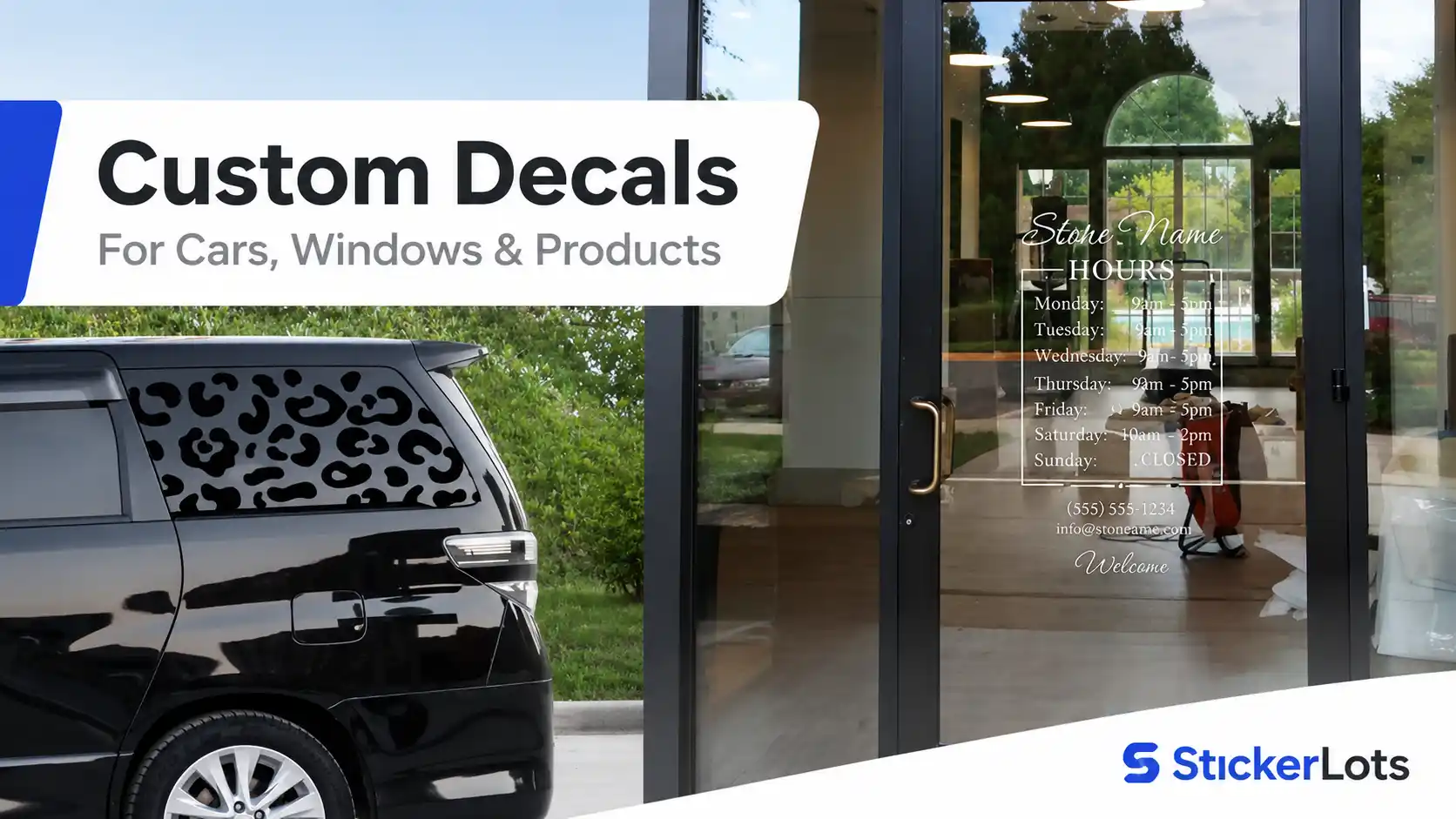
Window decals are great for storefronts, office doors, car windows, event signage, and glass product displays. You can use white vinyl, clear vinyl, perforated film, or specialty window materials depending on the look.
White vinyl gives strong contrast. Clear vinyl lets the glass show through. Perforated options can create visibility effects, though those are usually more specialized than a standard small decal order.
Before ordering, decide whether the decal should be applied to the outside of the glass or viewed through the glass from the inside. That one detail can change the artwork setup.
Product and Packaging Decals
For products, custom decals should match the surface and handling. A decal on a candle jar, coffee bag, plastic case, toolbox, or bottle may need moisture resistance, scuff resistance, or a cleaner finish.
This is where the decal-versus-label question comes up. If you are applying hundreds of the same design to packaging, roll labels may be more efficient. If you want a thicker, more durable branded piece that customers might keep, vinyl decals may make more sense.
Wall Decals
Wall decals are their own little universe. Smooth painted walls are easier than textured walls. Fresh paint, dust, humidity, and wall texture can all affect adhesion. If the decal is large, installation becomes more important too.
For interior wall decals, ask whether the material is meant for walls specifically. A strong permanent adhesive may stick well, but removal can be harder than you want.
Laptop, Bottle, and Gear Decals
For laptops, water bottles, helmets, coolers, and gear cases, laminated vinyl is usually a strong option. These surfaces get handled often, so the decal should resist scratches and moisture.
Small decals work well here, but do not shrink important text too much. A clean icon, logo, mascot, or short phrase usually works better than a paragraph.
Pick the Right Material and Adhesive
Most custom decals use vinyl because it is flexible, clean-looking, and durable. But the adhesive matters as much as the face material.
A permanent adhesive is best when the decal needs to stay in place for a long time. This is common for cars, equipment, outdoor use, and brand decals.
A removable adhesive is better for temporary promotions, short-term signage, rented spaces, seasonal displays, or surfaces where residue would be a problem.
A static cling is different from a normal decal because it does not use adhesive in the same way. It is useful for certain glass applications, temporary window graphics, parking permits, and seasonal signage.
The right adhesive is not about strongest equals best. Stronger can be better for long-term placement, but removable can be better when the surface matters more than maximum hold.
Finish Choices for Decals
Finish affects both appearance and readability.
Gloss decals look bright and eye-catching. They are good for bold logos, car graphics, colorful illustrations, and designs that benefit from shine.
Matte decals reduce glare and feel more understated. They are helpful when the design includes text or when the decal will be seen under bright indoor lighting.
Clear decals work well on glass, bottles, windows, and smooth packaging where you want the background to show. The design needs enough contrast, and white ink may be needed behind some colors.
Reflective or specialty materials can help certain vehicle, safety, or promotional decals stand out. Use them thoughtfully. They can add interest, but they can also make small text harder to read.
Artwork Setup Tips
Good decal artwork is simple, readable, and built for the final surface.
Use vector artwork for logos whenever possible. Vector files keep edges crisp and make resizing easier. High-resolution PNG files can work for illustrations or photo-style designs, but low-resolution screenshots rarely print cleanly.
Use bold lines. Thin details can disappear when a decal is cut small or viewed from a distance.
Give the cut line enough room. Do not place important text or details too close to the edge.
Think about contrast. A black decal on a dark tinted window may look subtle in a preview and almost invisible in real life. A white or light-colored design may work better.
Avoid tiny QR codes. QR codes need enough size and contrast to scan reliably. If scanning matters, test the code at final printed size before ordering a large batch.
For a real-world ordering example, CustomStickers.com’s custom vinyl decals page shows common options for vinyl decals, smooth-surface use, size choices, and indoor/outdoor applications.
Simple Decal Decision Guide
Use this quick framework before ordering custom decals:
For car windows: choose durable vinyl, strong contrast, and simple readable text.
For storefront glass: choose white or clear vinyl based on visibility and design style.
For product packaging: choose decals for durability or brand feel, but roll labels for high-volume application.
For walls: choose wall-friendly material and confirm the surface is smooth and clean.
For laptops and bottles: choose laminated vinyl with a finish that matches the artwork.
For temporary glass use: consider static cling instead of adhesive vinyl.
The boring details are what make the decal work. Size, surface, adhesive, and contrast will matter more than squeezing in one more tiny line of text.
Common Mistakes to Avoid
Do not order custom decals before deciding where they will go. A decal without a surface plan is just a tiny mystery project.
Do not assume every adhesive removes cleanly from every surface. Removal depends on material, adhesive, surface, age, heat, and installation.
Do not use small text on decals that need to be read from a distance. A car decal, storefront decal, or equipment decal should be readable quickly.
Do not forget to clean the surface before applying the decal. Dust, oil, wax, and moisture can weaken adhesion.
Do not skip proofing. The proof is where you catch cut line issues, spelling mistakes, size problems, and awkward spacing before the decal exists in physical reality, where mistakes become much more committed.
FAQs
Are custom decals the same as custom stickers?
Not exactly. People often use the terms interchangeably, but decals are usually more placement-focused. Stickers are often smaller handout items, while decals are often used on cars, windows, walls, products, or equipment.
What material is best for custom decals?
Vinyl is usually the best all-around material for custom decals because it is durable, flexible, and works well on many smooth surfaces. Specialty materials may be better for walls, temporary windows, or reflective uses.
Can custom decals go on cars?
Yes, many custom decals are made for car windows or vehicle surfaces. Use durable vinyl, strong contrast, and a size that is readable from a normal viewing distance.
Can decals be removed?
Some decals are removable, while others use stronger permanent adhesives. If clean removal matters, choose a removable material or ask before ordering.
What is the best size for a decal?
The best size depends on where the decal will be seen. Small decals work for laptops, bottles, and packaging. Larger decals work better for cars, windows, walls, and signs.