
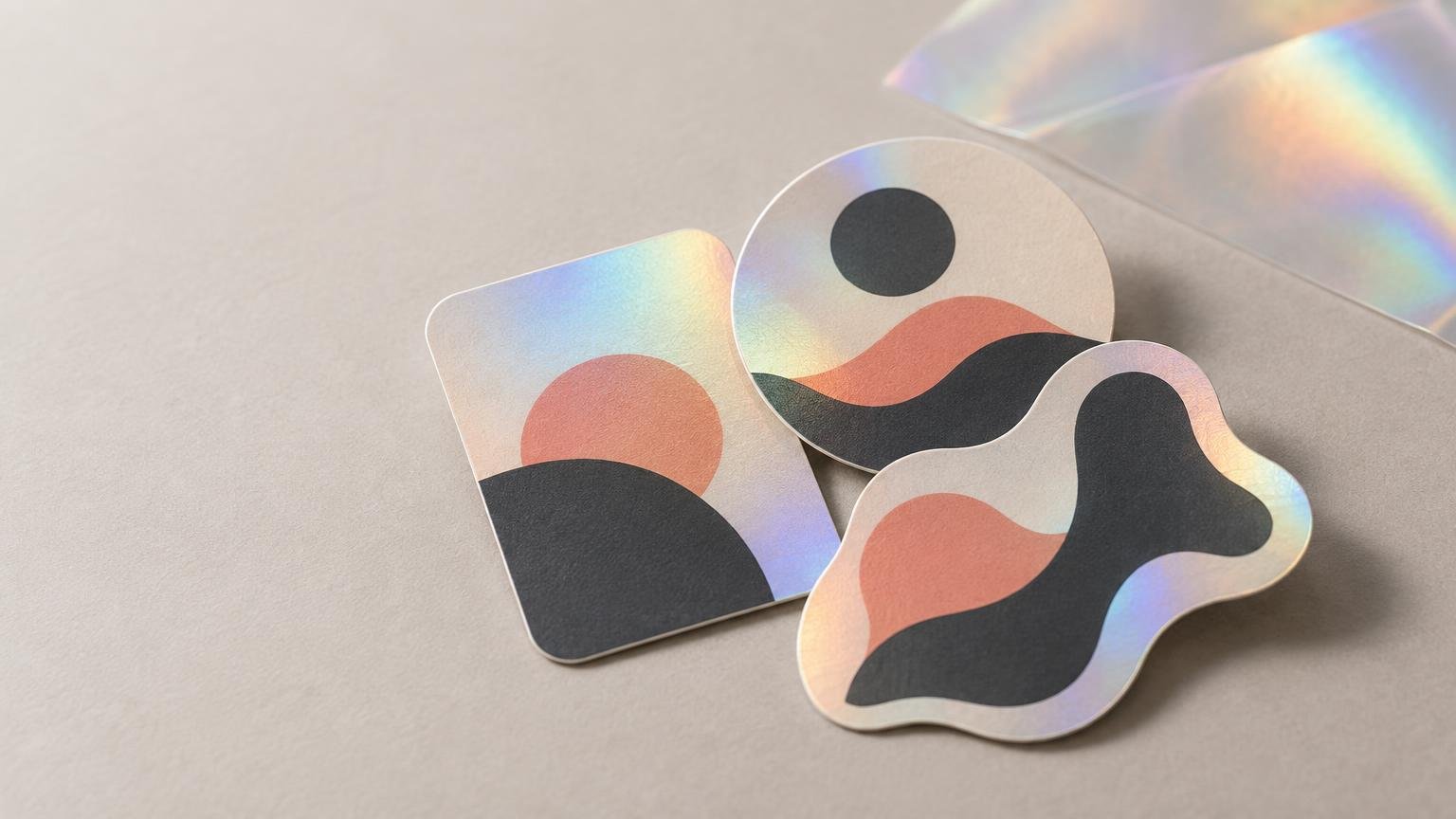
TLDR: The matte holographic stickers finish keeps the light-reactive holographic base but usually makes its rainbow effect softer and less reflective than a gloss finish. Choose it when you want restrained shimmer, lower glare, or a foil-like metallic impression. Before placing a large order, confirm how the printer uses white ink, proof brand-critical colors, test adhesion on the actual surface, and verify the complete material, laminate, adhesive, and durability specifications.
Matte holographic is a design tradeoff, not an automatic upgrade. It can give packaging, inserts, and promotional stickers a controlled specialty effect without the strong flash of glossy holographic material. Its success still depends on the artwork, lighting, application surface, sticker format, and construction supplied by the printer.
What a matte holographic stickers finish actually changes
The holographic effect and the matte surface usually come from different parts of the construction. The facestock or base film creates the shifting colors. A matte laminate or top layer changes how light reflects from the face of the sticker. In one manufacturer’s holographic construction, matte laminate creates a subtler effect while gloss makes the holographic appearance more pronounced.
Matte therefore softens the rainbow flash rather than necessarily eliminating it. The result can appear metallic or foil-like, especially when artwork uses gold, silver, bronze, or other muted tones. That description is useful for planning a visual direction, but it is not a universal production guarantee: the exact look changes with the printer’s film, laminate, ink system, artwork, and lighting.
A matte holographic sticker can still look quiet from one angle and colorful from another. If the project depends on a very specific amount of shimmer, a digital mockup is not enough. Request a physical sample or proof using the intended construction.
Matte versus gloss holographic stickers
| Decision factor | Matte holographic | Gloss holographic |
|---|---|---|
| Visual effect | Softer shimmer and a more restrained metallic impression | Stronger shine and more obvious rainbow movement |
| Glare | Usually more controlled under bright or mixed lighting | More direct reflection and flash |
| Artwork emphasis | Can let typography and restrained designs remain prominent | Often makes the specialty material a leading visual feature |
| Photography | May be easier to control, but angle still changes the effect | Can deliver dramatic highlights but may create stronger reflections |
| Best starting point | Premium packaging, small text, subdued branding, or controlled shimmer | Giveaways, bold graphics, attention-led promotions, or maximum holographic visibility |
Neither finish is inherently better. Matte is the stronger starting point when readability and controlled reflection matter more than maximum sparkle. Gloss makes more sense when the rainbow effect is the reason the sticker exists. For a broader comparison beyond holographic stock, see the guide to matte versus gloss stickers.
Artwork controls how much holographic material you see
The topcoat is only part of the result. Artwork coverage determines where the holographic base remains visible. Open or unprinted areas reveal more of the material, while dark, opaque, or heavily printed areas can suppress its effect. Some printers offer white ink to mask the holographic layer beneath selected artwork.
Think of the artwork as a map with three possible treatments:
- Open holographic areas: Leave selected shapes or backgrounds unprinted when you want the base material to provide the effect.
- Printed color over holographic stock: Use this when you want color plus light-reactive movement, while recognizing that the result may differ from color printed on white material.
- White-backed areas: Ask for a selective white underbase beneath logos, faces, fine text, product information, or other elements that should look more conventional and opaque.
Colors printed on holographic stock may appear darker or more muted than expected. That makes a physical proof particularly valuable for skin tones, pale colors, neutral brand palettes, gradients, and products that must match an established packaging system.
Protect readability before maximizing shimmer
Small text, QR codes, barcodes, and required product information should not depend on a shifting background for contrast. Ask the printer whether those areas can receive a white underbase, and test the finished piece under the lighting in which it will be scanned or read. The same transparency and contrast principles covered in this guide to clear sticker design and white ink are useful here, even though holographic and clear materials create different effects.
Judge the finish in the lighting that matters
Holographic material changes with angle and illumination. A sticker viewed under retail spotlights can look different beside a window, in soft indoor light, at an outdoor event, or in product photography. Matte reduces the emphasis on direct reflection, but it does not make appearance independent of lighting.
Evaluate samples in at least the main sales or distribution setting. For ecommerce packaging, also photograph the sample with the equipment normally used for product images and social posts. If employees will apply the stickers, check appearance at arm’s length as well as close up. If customers will scan a code, test scanning from several realistic angles.
Finish and adhesive performance are separate decisions
A matte face does not tell you whether the adhesive is suitable for a carton, jar, pouch, bottle, mailer, or product insert. Adhesion depends on the adhesive system, the substrate, surface texture, cleanliness, moisture, application conditions, and sometimes the flexibility of the package.
The 3M substrate selection and preparation bulletin identifies clean, dry, smooth, relatively nonporous surfaces as favorable for film adhesion. It also notes that moisture and texture can reduce adhesive contact. This supports a simple rule: test the complete sticker on the actual package rather than choosing by finish alone.
Be especially cautious with textured paper, flexible pouches, oily containers, damp or refrigerated packaging, silicone, and other difficult plastics. Clean a representative surface using a method compatible with the package, apply the sticker as it will be applied in production, and observe the edges and corners through realistic storage and handling.
Do not infer durability from the word “laminate”
A laminate can be part of a protective construction, but “matte laminated” does not by itself establish that a sticker is waterproof, dishwasher-safe, UV-resistant, chemical-resistant, or rated for outdoor use. Those claims depend on the exact facestock, ink, top layer, adhesive, printing process, and exposure conditions.
Printers may also sell roll stickers and packaging labels with different protective properties even when the products look similar online. Before ordering, ask for the specification attached to the exact product and finish in the quote. If the sticker will encounter oil, abrasion, refrigeration, sunlight, cleaning products, or repeated handling, name that exposure directly rather than asking only whether the product is “durable.”
Choose a format that matches distribution
The finish attracts attention, but format determines how efficiently the stickers can be stored, handed out, peeled, and applied.
- Die-cut singles suit giveaways, order inserts, merchandise bundles, and situations where the sticker itself is part of the presentation.
- Kiss-cut singles leave extra backing around the cut sticker, which can make delicate shapes or small stickers easier to handle and peel.
- Roll stickers suit repeated application to products, mailers, jars, bottles, cartons, or bags, provided the roll direction and core specifications fit the workflow.
- Packaging labels may be configured differently from promotional stickers, so verify the material, adhesive, laminate, and intended exposure rather than treating the terms as interchangeable.
At least one manufacturer offers roll-format holographic stickers with permanent acrylic adhesive and a choice of matte or gloss laminate, illustrating why buyers should review the product-specific format and adhesive instead of assuming all holographic stickers share one construction. Use the die-cut versus kiss-cut comparison for individual pieces, or the guide to sticker rolls and custom roll labels when application speed is the main concern.
Plan the order quantity around uncertainty
Specialty material creates more variables than a routine reorder on familiar white stock. A lower unit price at a large quantity is not a saving if the colors look wrong, codes will not scan, or the adhesive lifts from the package.
Start with a sample or pilot whenever you are changing the finish, artwork coverage, white-ink treatment, supplier, packaging substrate, application process, or lighting context. A transparent hypothetical plan for an eventual 5,000-piece requirement might be to order a small proof batch first, use it on filled packages, review it after normal handling, and approve the remaining quantity only after the design and construction pass. The right pilot quantity depends on supplier minimums and how many application conditions need testing.
The economic question is not merely “Which quantity has the lowest unit price?” It is “How many can we confidently use before the artwork, package, campaign, or legal copy changes?” If a redesign is plausible within a few months, reorder flexibility may be more valuable than the deepest quantity break. Once the design and application are stable, bulk custom sticker ordering becomes easier to justify.
Preorder checklist
- Confirm the holographic facestock, matte laminate, adhesive, and printing method.
- Ask where holographic material will remain exposed and where color will print over it.
- Specify any logo, text, barcode, QR code, or product information that may need white ink beneath it.
- Review a physical sample under retail, office, event, daylight, and photography conditions that matter to the project.
- Apply samples to the actual cleaned package, including curved, flexible, textured, oily, or refrigerated versions where relevant.
- Request durability specifications for the exact construction and intended exposure.
- Choose singles, kiss-cut pieces, rolls, or labels based on distribution and application speed.
- Check roll direction and equipment compatibility for repeated application.
- Calculate quantity from realistic usage, campaign duration, storage, spoilage, and redesign risk.
- Keep an approved physical sample or production reference for repeat orders.
Common questions about matte holographic stickers
Do matte holographic stickers still show a rainbow effect?
Usually, yes. Matte tends to soften the effect rather than remove it. How visible the rainbow remains depends on the material, laminate, artwork coverage, viewing angle, and lighting.
Will matte laminate change brand colors?
It can change their appearance, especially when ink is printed directly over holographic stock. Ask about a white underbase and approve a physical proof when color consistency matters.
Are matte holographic stickers waterproof?
The finish name alone does not answer that question. Verify the water, abrasion, UV, temperature, and chemical-resistance specifications for the printer’s exact material and adhesive construction.
Are they suitable for product packaging?
They can be, but suitability depends on the package surface, adhesive, exposure, artwork, and application workflow. Test the sticker on a filled representative package before committing to a large run.
The practical choice
Choose matte holographic when you want the base material to add movement and perceived detail without making maximum rainbow shine the dominant feature. Choose gloss when strong flash is central to the design. In either case, the most important decisions happen below the finish: artwork coverage, white ink, color proofing, adhesive, application surface, durability, and format.
Before comparing quantities or ordering custom sticker options, obtain the complete construction specifications and a physical sample. Approve the appearance in real lighting, test it on the real surface, and then scale the order to the period in which the design can confidently remain in use.
References
- What Are Holographic Die Cut Stickers? – StickerGiant
- Do You Offer Foil or Metallic? – StickerGiant
- Holographic Sticker Material Details | FAQ
- Application: Substrate Selection and Preparation
- What's the Difference between Labels and Stickers on Rolls? – StickerGiant
- Kiss Cut Holographic Stickers Custom Printed